The SaaS finance library.
61 guides on revenue recognition, cash, the close, tax, entities and the raise, written for founders and the people who run their numbers.
 ASC 606 for SaaS: The Five Steps, Applied to SubscriptionsHow the five-step model works for annual prepaid plans, multi-year deals, implementation fees and usage, and what your auditor will test first.
 Burn Multiple: What It Measures and How to Calculate It RightNet burn divided by net new ARR: the capital-efficiency number investors check first, how to compute it from your books, and how to move it.
 The SaaS Month-End Close ChecklistEvery step of an accrual close for a SaaS company, in order: cash, revenue, expenses, accruals, reconciliations, review and the finance pack.
Revenue
ASC 606, deferred revenue, ARR and retention: the numbers a buyer or an auditor will rebuild.
ASC 606 for SaaS: The Five Steps, Applied to SubscriptionsHow the five-step model works for annual prepaid plans, multi-year deals, implementation fees and usage, and what your auditor will test first. Bookings vs. Billings vs. Revenue vs. ARRFour numbers that describe the same contracts at different moments. How each is defined, how they reconcile, and which one belongs on which slide.
 Capitalizing Sales Commissions Under ASC 340-40Which commissions are capitalized, how long to amortize them, the one-year practical expedient and the schedule auditors expect.
 Churn: Logo Churn, Revenue Churn and What to ReportMonthly versus annual churn, logo versus revenue churn, gross versus net: the definitions, a worked example and the version investors expect.
 Implementation and Onboarding Fees Under ASC 606When a setup fee is a separate performance obligation, when it is combined with the subscription, and how to recognize it either way.
 NRR and GRR: Calculating Retention the Way Investors DoNet and gross revenue retention, computed cohort-style from your ARR bridge, with the definition choices that change the answer by several points.
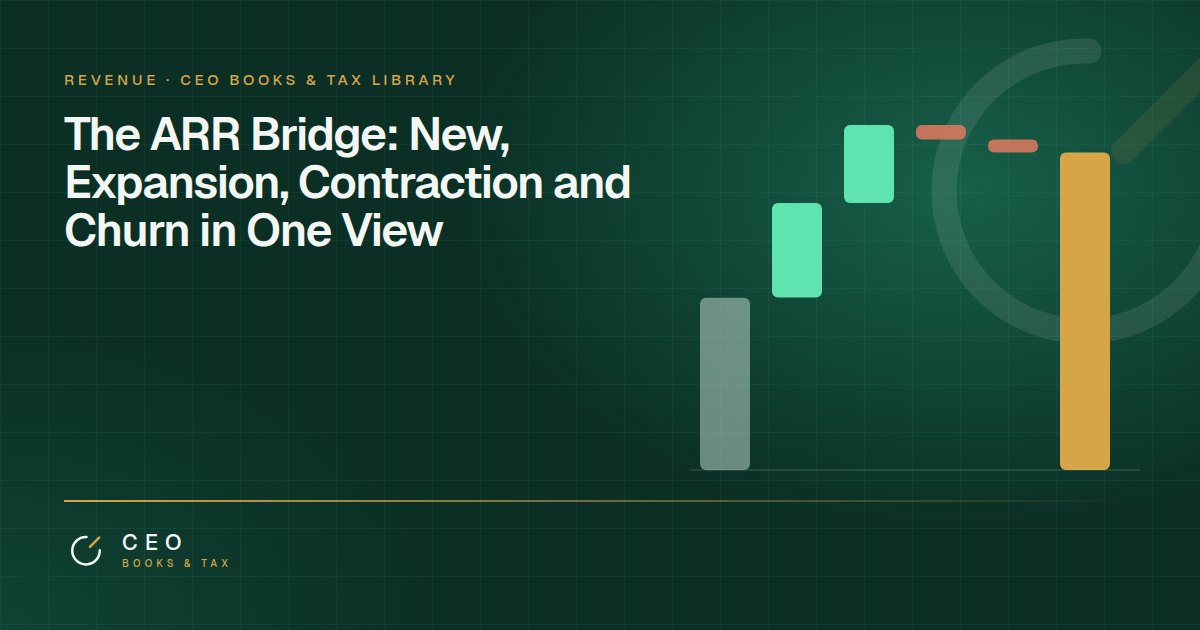 The ARR Bridge: New, Expansion, Contraction and Churn in One ViewHow to build an ARR or MRR bridge that ties to your billing data, what each bar should mean, and the definitions investors will check.
 The Deferred Revenue Roll-Forward: How to Build It and Tie It OutThe one schedule that proves your revenue is right: opening balance, billings, recognition, closing balance, tied to the billing system every month.
 Upgrades, Downgrades and Add-Ons: Contract Modifications Under ASC 606Mid-term seat adds, plan upgrades, downgrades and early renewals: which are new contracts, which are prospective changes, and why proration is not the answer.
 Usage-Based Pricing: Revenue Recognition and ForecastingCommitments, overages, prepaid credits and true-ups: how consumption pricing is recognized under ASC 606 and how to forecast it without guessing.
Cash
Burn, runway, margins and unit economics: what tells you how long you have and what each dollar buys.
Burn Multiple: What It Measures and How to Calculate It RightNet burn divided by net new ARR: the capital-efficiency number investors check first, how to compute it from your books, and how to move it. Accounts Receivable, Collections and DSO for SaaSInvoicing on time, a collections cadence that customers respect, DSO calculated correctly, and how the allowance for credit losses is set under ASC 326.
 Accrual vs. Cash Accounting for SaaS CompaniesWhy investors expect accrual books, when a SaaS company may still use the cash method for tax, and how the two are reconciled each year.
 Budget vs. Actuals: A Monthly Variance Review That Drives DecisionsHow to build an annual budget your ledger can be compared against, write variance commentary that matters, and reforecast without losing the plan.
 Building a SaaS Operating Model and Headcount PlanA driver-based monthly model: ARR cohorts, hiring by role, cost of revenue, opex and cash, built on your chart of accounts so it can be compared to actuals.
 CAC Payback: The Formula, the Inputs and the TrapsHow many months of gross profit it takes to earn back the cost of acquiring a customer, computed from the ledger rather than a marketing dashboard.
 LTV to CAC: Calculating Customer Lifetime Value HonestlyLifetime value built on gross profit and real retention, CAC fully loaded from the ledger, and why young companies should lead with payback instead.
 Runway and the 13-Week Cash Forecast: A Practical BuildRunway from a model you trust: a rolling 13-week direct cash forecast, the monthly operating model behind it, and the triggers that tell you to act.
 SaaS Gross Margin: What Belongs in Cost of RevenueHosting, support, onboarding, payment fees and third-party software: how to classify cost of revenue so gross margin is right and comparable.
 The Rule of 40: How to Calculate It and When It MattersGrowth rate plus profit margin: which growth rate, which margin, how to calculate it from your books, and why it matters more as a company scales.
 Treasury Management for Venture-Backed StartupsWhere to hold a raise: operating accounts, sweep and insured cash programs, Treasury bills and money market funds, with a written policy the board approves.
Close
The monthly close, the ledger and the systems underneath it.
The SaaS Month-End Close ChecklistEvery step of an accrual close for a SaaS company, in order: cash, revenue, expenses, accruals, reconciliations, review and the finance pack. A Chart of Accounts Built for SaaSAccounts and departments that produce SaaS gross margin, opex by function and clean ARR reporting straight from the ledger, without spreadsheet surgery.
 Capitalized Software Development Costs Under ASC 350-40Which engineering costs a SaaS company can capitalize, how the stages work today, what ASU 2025-06 changes, and how the tax side differs.
 Catch-Up Bookkeeping: Cleaning Up Months of Startup BooksHow a SaaS company brings neglected books current: the order of work, what gets rebuilt, and how to file returns that are late or on extension.
 Choosing an Accounting Platform for a SaaS CompanyQuickBooks Online, Xero, NetSuite, Sage Intacct or Zoho Books: how to choose by entity count, revenue complexity and audit needs, not by brand.
 Getting Ready for Your First Financial Statement AuditWhy SaaS companies get audited, what auditors test first, the PBC list, opening balances and the cleanup that makes the first audit shorter.
 Prepaid Expenses and Accruals: Getting Expenses Into the Right MonthAnnual software contracts, insurance, unbilled contractor work and bonuses: the entries that make monthly expenses accurate, with a schedule for each.
 Reconciling Payment Processor Payouts to RevenueWhy the deposit in your bank never equals your revenue, and the clearing-account method that ties gross charges, fees, refunds and disputes to every payout.
 Stock-Based Compensation Accounting Under ASC 718Grant-date fair value, expense over the vesting period, forfeitures, the inputs private companies use, and the tax forms that follow option exercises.
Tax
Federal, state and sales tax for venture-backed C-corps, plus the credits SaaS companies leave behind.
 The R&D Tax Credit for SaaS Companies (IRC §41)Which software work qualifies, how qualified research expenses are counted, the two credit methods, and the payroll tax election for early-stage companies.
 1099s for Startups: Who Gets One, the New $2,000 Threshold and DeadlinesContractor reporting for SaaS companies: the threshold change for 2026 payments, W-9 collection, NEC versus MISC, and the January deadline.
 Corporate Estimated Tax Payments for SaaS CompaniesWhen a C corporation must pay quarterly, the four installment dates, the safe harbors, the large-corporation rule and how the penalty is figured.
 Delaware Franchise Tax: Authorized Shares vs. Assumed Par ValueWhy a startup with 10 million authorized shares gets a five-figure bill, how the Assumed Par Value Capital method brings it down, and the March 1 deadline.
 Form 1120 for Venture-Backed C CorporationsWhat a loss-making Delaware C corporation files each year, the schedules that trip startups up, net operating losses, and the forms that ride along.
 IRS Notices and Penalty Abatement for StartupsHow to read an IRS notice, respond by the deadline, and request first-time abatement or reasonable-cause relief for late filing, payment and deposit penalties.
 Multi-State Payroll for Remote SaaS TeamsWhat happens when a startup hires in a new state: registrations, withholding, unemployment insurance, local taxes and the knock-on effects for income tax.
 Offer in Compromise and Other Ways to Resolve an IRS BalanceHow the IRS evaluates an offer in compromise, the fee and payment rules, who qualifies, and the alternatives that fit most operating businesses better.
 QSBS (Section 1202) for SaaS Founders After the 2025 ChangesQualified small business stock can exclude most or all of a founder's gain on a sale. What qualifies, what changed for stock issued after July 4, 2025, and what to document now.
 Sales Tax Nexus for SaaS: Wayfair, Thresholds and TaxabilityEconomic nexus since Wayfair, how state thresholds work, why SaaS taxability varies by state, and how to fix exposure before diligence finds it.
 Sales Tax Voluntary Disclosure Agreements for SaaSHow a SaaS company that crossed economic nexus thresholds without registering can come forward: limited look-back, penalty waiver, and the steps in order.
 Section 174 and 174A After 2025: Deducting Software Development AgainDomestic research costs are deductible again for tax years beginning after 2024, with a retroactive option for smaller companies. What changed and what to decide.
 State Income Tax Nexus for SaaS CompaniesWhy P.L. 86-272 rarely protects SaaS, how economic nexus and market-based sourcing work, and the gross receipts taxes that apply even at a loss.
 The 83(b) Election: A 30-Day Deadline Founders Cannot MissWhat an 83(b) election does for founders and early employees with restricted stock, the 30-day deadline, Form 15620, and what to keep on file.
Entities
Structures, consolidation, good standing and the compliance calendar across every entity you own.
 Multi-Entity Consolidation and Intercompany AccountingFive LLCs, two corporations and a holding company: how to keep separate books, book intercompany correctly and produce one consolidated view every month.
 Beneficial Ownership Reporting: Where It Stands for U.S. StartupsWhat the Corporate Transparency Act required, how FinCEN's 2025 interim rule and 2026 final rule exempted U.S. companies, who still reports, and the state rules to watch.
 Converting an LLC to a Delaware C CorporationThe three ways to convert, how the IRS treats each, what happens to QSBS and the EIN, and the accounting and tax work that follows.
 Foreign Qualification, Registered Agents and Good StandingWhen a Delaware company must register in another state, what a registered agent does, and how to keep and prove good standing for banks, investors and buyers.
 Foreign Subsidiaries and Transfer Pricing for SaaS StartupsWhen a U.S. SaaS company sets up an engineering or sales subsidiary abroad: intercompany agreements, cost-plus pricing, Form 5471 and the books that hold it together.
 Holding Company Structures for Founders With Several BusinessesWhen a holding company makes sense, the common structures, how cash and IP move between entities, and the accounting and tax each choice creates.
 LLC vs. C Corporation for a SaaS StartupHow the two entities differ on tax, equity, investors and exit, why venture-backed SaaS companies usually end up as Delaware C corporations, and when an LLC still fits.
 The Annual Compliance Calendar for a Delaware SaaS CompanyEvery recurring federal, Delaware, payroll and securities deadline a venture-backed SaaS company faces, in one calendar, with the event-driven ones listed separately.
Board & raise
Board packs, diligence, 409A, SAFEs, venture debt and the data room.
 Series A Financial Diligence: What Investors Will Ask ForThe finance requests in a Series A diligence list, the issues that slow or reprice a deal, and how to have every answer in the data room before the term sheet.
 409A Valuations: When You Need One and What Finance ProvidesWhy option strike prices need a 409A, the safe harbor, how long a valuation lasts, the events that refresh it, and the financial package the appraiser needs.
 Cap Table Hygiene Before Your Next RoundTying the cap table to board approvals, stock ledgers and the general ledger; fixing missing approvals with Section 204; and the option-plan limits that catch startups.
 Monthly Investor Updates That Investors ReadA one-page investor update built from the monthly close: the metrics, the definitions, the asks, and the consistency that makes the next raise easier.
 SAFE Accounting and Conversion MathHow post-money SAFEs convert in a priced round, the dilution math founders should run first, how SAFEs are classified on the balance sheet, and the filings that follow.
 Selling a SaaS Company: Quality of Earnings and Sell-Side DiligenceWhat a buyer's quality of earnings review tests, how adjusted EBITDA and net working capital pegs are set, debt-like items, and preparing before the process starts.
 The Finance Data Room Checklist for a SaaS RaiseThe folders and documents investors request in financial diligence, how to organize them, and which ones take longest to produce.
 The Finance Pages of a SaaS Board DeckThe six finance pages every board meeting needs, what goes on each, and how to build them from the close so the deck is ready before the meeting.
 Venture Debt: What Lenders Look For and How to Account for ItWhen venture debt makes sense, what lenders underwrite, the terms to model, and how warrants, fees and interest are recorded under GAAP.
No guide matches that yet. Try another term, or ask us on a scope call.
Want this run for you, every month?
Revenue recognition, the close, cash, tax and board reporting, run by senior finance people in the accounting software you already use.