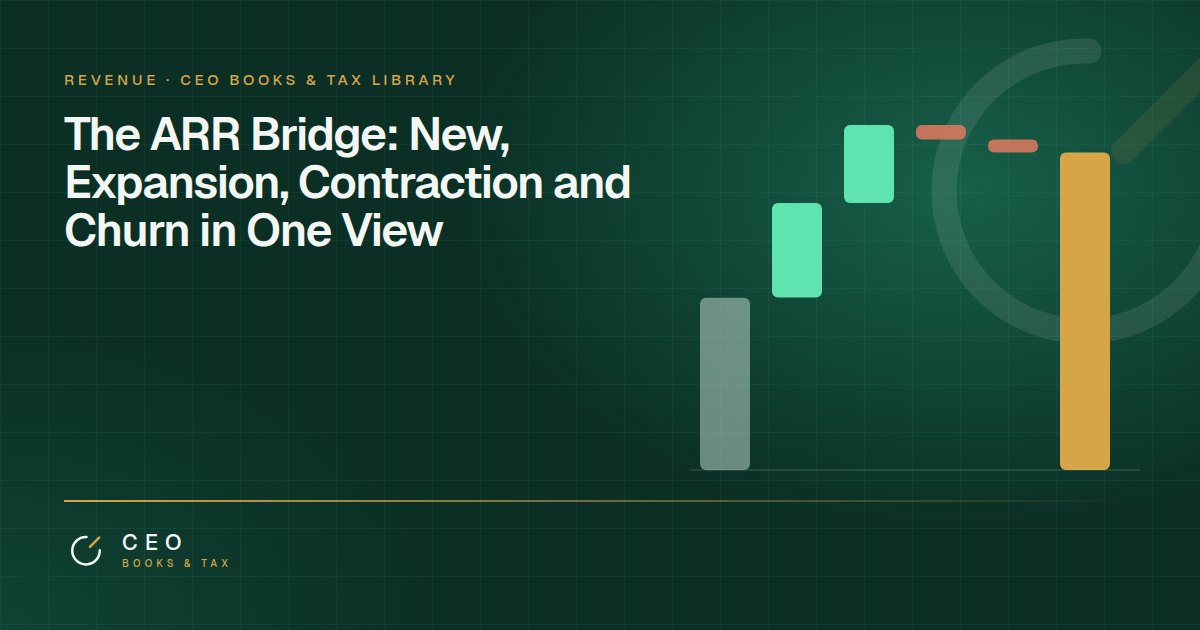
The ARR bridge is the single most-read page in a SaaS board pack. It answers the question every investor asks first: where did the growth come from, and how much leaked out the back? Built well, it reconciles to your billing data and your GAAP revenue. Built loosely, it is the first metric diligence rebuilds.
The bridge
| Bar | Definition |
|---|---|
| Starting ARR | Annualized recurring revenue at the end of the prior period |
| + New | ARR from customers who were not customers at the start of the period |
| + Expansion | Increases from existing customers: seats, upgrades, price increases, cross-sell |
| − Contraction | Decreases from customers who stayed: downgrades, fewer seats, discounts |
| − Churn | ARR from customers who left entirely |
| Ending ARR | Starting ARR plus the four movements |
The same structure works monthly in MRR terms. ARR is commonly MRR times twelve, or the annualized value of contracted subscriptions; pick one definition and keep it.
Definitions to write down before you build
- What counts as recurring. Subscription fees and committed minimums usually yes; usage above commitments and one-time services usually no, or shown separately.
- When ARR starts. At contract start date, not signature date and not invoice date.
- Reactivations. A churned customer who returns: new or expansion? Most companies treat a return after a set gap (often a full quarter) as new.
- Multi-year price ramps. Use the current period's contracted amount, not the average across years.
- Currency. Fix the exchange rate used for ARR so FX does not show up as expansion or churn.
Tie it to the books
ARR is not GAAP, but it should be explainable against GAAP subscription revenue. A useful monthly check: MRR at month end versus recognized subscription revenue for the month. Differences should be explainable by mid-month starts, ramps and timing; a growing unexplained gap is a signal that the metric or the revenue schedule is drifting.
Reading the bridge
- Expansion greater than contraction and churn combined means net revenue retention above 100%: the installed base grows on its own.
- Large new, large churn means the top of the funnel is masking a retention problem.
- Lumpy expansion often signals annual true-ups or price increases; label them so the board does not read them as product pull.
How we build it
We pull subscription data from the billing system, classify every customer movement by the written definitions, roll the bridge monthly and reconcile it to recognized revenue. The output sits next to NRR, GRR and the deferred revenue roll-forward in your monthly finance pack.
Related metrics
The bridge feeds net revenue retention (NRR), gross revenue retention (GRR), the burn multiple (net new ARR is its denominator) and CAC payback. Get the bridge right and the rest of the metrics page follows.
A worked monthly example
| Bar | MRR |
|---|---|
| Starting MRR | $250,000 |
| + New | $14,000 |
| + Expansion | $9,500 |
| − Contraction | $2,000 |
| − Churn | $4,500 |
| Ending MRR | $267,000 |
Annualized, ending ARR is $3,204,000 and net new ARR for the month is $204,000. The same table, rolled up by quarter, is the second page of the board pack.
Data hygiene that keeps it accurate
- One customer identifier shared by the billing system, CRM and accounting.
- Contract start and end dates on every subscription record.
- A rule for credits and discounts so they do not show up as contraction one month and expansion the next.
Sources
- SEC, Commission Guidance on Management's Discussion and Analysis (key performance indicators and metrics), Release 33-10751 (PDF)
- FASB Accounting Standards Codification, Topic 606, Revenue from Contracts with Customers
Questions founders ask
Is ARR a GAAP number?
No. ARR is an operating metric, so define it in writing and apply it the same way every month. It should reconcile to GAAP subscription revenue within a reasonable band.
Should one-time fees be in ARR?
No. Implementation, training and other non-recurring fees are excluded from ARR, even when they are recognized over time for GAAP.