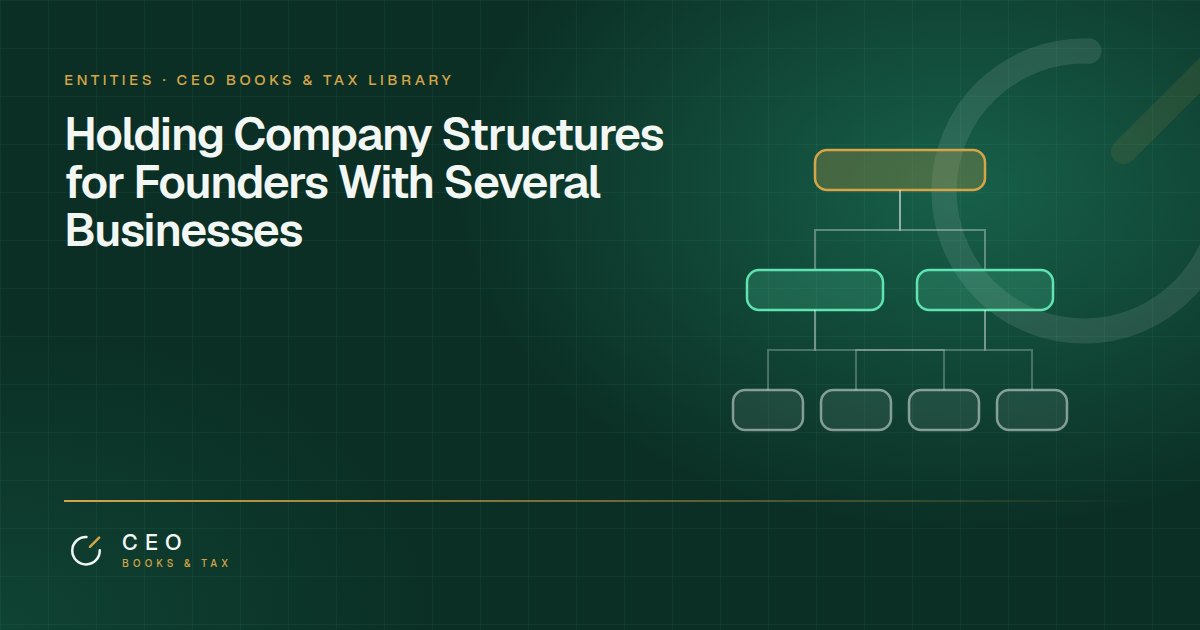
Founders who run several businesses often reach for a holding company: one parent entity that owns the operating companies. It can be the right structure, but it creates accounting, tax and investor considerations that are easier to plan than to unwind.
Why founders use one
- Liability separation. Each operating business sits in its own entity, so a problem in one does not reach the others' assets.
- Clean ownership. Partners or investors can own one subsidiary without owning everything.
- Shared services. Finance, HR and management can sit at the parent and be charged out.
- Cash management. Distributions can flow up to the parent and be redeployed.
Common structures
| Structure | Typical use |
|---|---|
| LLC parent owning LLC subsidiaries | Service businesses, real estate, lifestyle portfolios; pass-through taxation |
| C-corp parent owning C-corp subsidiaries | Groups that want a consolidated federal return |
| Founder-owned holding LLC plus a separately owned venture-backed C-corp | Keeps the venture company's cap table clean while the founder's other businesses sit in the holding company |
| Operating company with an IP subsidiary | Separates intellectual property; requires real licensing terms |
How money and IP move
Every movement between entities needs a documented basis: management services agreements, license agreements, loans with terms, or distributions approved by the owner. Undocumented transfers create intercompany balances nobody can explain, and in a dispute or diligence they blur the separation that was the point of the structure.
Tax mapping
- Affiliated C-corporations meeting the 80% ownership test can elect a consolidated federal return.
- LLCs file according to their classification: disregarded, partnership or corporate election.
- An S-corporation cannot have a corporate or partnership owner.
- Holding venture-company stock through an entity can affect a founder's QSBS treatment.
Accounting
Each entity keeps separate books. The parent consolidates entities it controls, eliminating intercompany activity. The owner sees each entity's results and the consolidated total every month.
How we help
We map the structure, set up each entity's books and intercompany agreements, run the consolidated close and maintain one compliance calendar across every entity. Structure decisions involve legal judgment, so we work alongside your attorney on formation documents.
Questions to answer before forming a parent
- Who will own each entity in five years: you alone, partners, investors?
- Will any entity raise venture capital? If so, keep its cap table simple from day one.
- Do the businesses share people, offices or systems that will need to be charged between entities?
- Where does the intellectual property sit, and who needs a license to use it?
- Which entities will have taxable income, and which will produce losses?
The answers usually point to the right structure faster than comparing entity types in the abstract.
Costs of a structure
Every additional entity brings its own bank accounts, books, tax returns, state filings and registered agent. A structure that saves on liability exposure but adds five sets of compliance needs to be worth it. We show founders the annual compliance calendar for a proposed structure before it is formed.
Unwinding is harder than forming
Moving assets out of an entity, merging subsidiaries or converting entity types can trigger tax and requires legal steps. Structures chosen deliberately at the start avoid most of that.
Reporting the founder actually wants
Most owners of several businesses want two views: each company on its own, and everything together. With separate books, documented intercompany activity and a consolidated close, both come out of the same monthly process.
Sources
Questions founders ask
Does a holding company reduce taxes by itself?
Not by itself. Its value is in liability separation, ownership flexibility and, for qualifying C-corporation groups, the option of a consolidated federal return. The tax result depends on each entity's classification.
Can a venture-backed C-corp be owned by a holding company?
Investors usually want founders to hold operating company shares directly, and holding stock through an entity can affect QSBS eligibility for the founder. Decide this with counsel before the first priced round.